

When the Clock Strikes Midnight
On leaving America, restoring old stones, and the strange comfort of realizing the world isn’t falling apart — it’s turning over.

Key Takeaways: When the Clock Strikes Midnight
- The chaos isn’t random — History moves in nested cycles of 80, 400, and 2,000 years, and all three are hitting their reset point at the same time
- The system isn’t broken, it’s finished — The 400-year Enlightenment model of centralization and top-down control has reached the end of what it was designed to do
- Your gut is telling you the truth — That persistent feeling that the world has stopped making sense is your instinct recognizing a structural shift, not anxiety to be medicated away
- The old ways aren’t nostalgic, they’re strategic — Traditional knowledge, seed-saving, plant medicine, and building from durable materials are survival skills for what comes next
- Midnight is a door, not a dead end — Every previous reset in history produced something new, built by the people who carried essential wisdom through the fire
- You were designed for this moment — You don’t have to move to France, but you can start carrying seeds: learn to grow, learn to heal, learn to build things meant to outlast you
- Faith over fear — Paul’s call to wake out of sleep isn’t a warning to be afraid; it’s an invitation to recognize the moment and step into it with purpose
I’ve been sitting with something for a few days now, and I need to write it out by hand before it slips away from me. Not type it. Write it. Because some thoughts need the slow drag of ink on paper before they’ll hold still long enough to be understood.
A video came across my screen recently that stopped me cold. It was one of those rare pieces of content that doesn’t just inform you — it names the thing you’ve been feeling in your bones but couldn’t articulate. The creator laid out a framework for understanding why the world feels the way it does right now, and he did it with a precision that made the hair on my arms stand up.
His argument, in essence, is that history doesn’t move in a straight line. It moves in nested cycles — gears, he calls them — and right now, three of those gears are hitting midnight at exactly the same time. An 80-year human memory cycle. A 400-year civilizational operating system. And a 2,000-year macro-reset that redefines what it means to be human. All converging. All right now.
I sat there in my kitchen in the Creuse, in this 170-year-old stone house I bought for €23,000, and I thought: I know.
Not because I’m a historian or a political theorist. But because I’ve been living the response to this for years now, long before I had a name for it.
The Feeling That Came Before the Framework
When I left America, people thought I’d lost my mind. A woman in her seventies, recently widowed, packing up and moving to rural France to restore a crumbling stone house and grow a medieval garden. My children said I was too old for crazy dreams. Friends were polite about it, which is the southern way of saying they were worried.
But here’s what I couldn’t explain to them at the time, because I didn’t have the vocabulary yet: something in my gut was telling me that the system I’d spent my whole life inside was no longer going to hold. Not in a dramatic, bunker-and-canned-goods way. In a quieter, more structural way. The institutions I’d trusted — the medical system, the financial architecture, the cultural assumptions that held everything together — they weren’t just getting worse. They were getting brittle.
I’m a clinical herbalist. I’ve spent over twenty years watching the gap widen between what modern medicine promises and what it actually delivers for most people. I’ve watched the pharmaceutical model become so centralized, so top-down, so disconnected from the individual body in front of it, that it can no longer solve the problems it was designed for. I’ve watched people get sicker on the very protocols that were supposed to make them well.
That’s not a political statement. It’s a clinical observation. And it’s exactly what this video describes happening at the civilizational level: a 400-year operating system that was brilliant in its time — logic, centralization, top-down control — reaching the end of its usefulness. The tools that built the modern world are now the things destroying it. Centralization was a benefit in 1800. In 2026, it’s a strangling noose.
I didn’t need a historical framework to feel that. My body knew it. My practice knew it. And apparently, my feet knew it, because they carried me to France.
Old Stones and Living Memory
The video talks about something the ancient Etruscans understood: that collective memory has a biological expiration date. About 80 to 100 years — the span of a long human life. As long as one person remains alive who actually witnessed the last great crisis, society keeps its guard up. The moment that last eyewitness dies, the shield drops. The next generation walks right back into the fire because nobody’s left to say, I saw it. We must never go back.
I think about that every single day in this house.
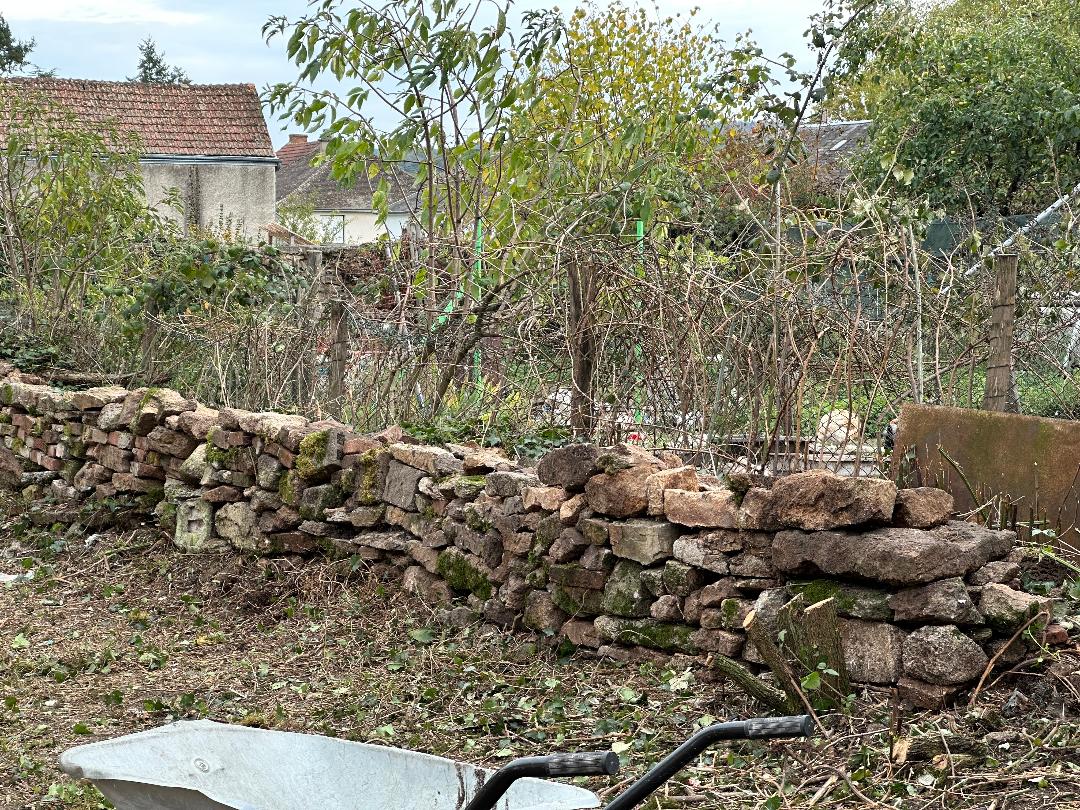
These walls are 170 years old. The stones were cut and laid by hands that knew how to build something meant to last generations, not quarterly earnings cycles. The garden behind this house has been growing food and medicine for longer than some countries have existed. When I put my hands on these walls, I’m touching the work of people who understood something we’ve forgotten: that you build from materials that outlast you. That you grow what sustains you. That you pass down knowledge not in databases but in soil and stone and the memory of your hands.
The modern world doesn’t build like this anymore. It builds fast and cheap and disposable, because the operating system rewards speed over durability. But when the operating system crashes — and it is crashing, you can hear the gears grinding if you’re quiet enough — what survives? The stone walls. The heirloom seeds. The old ways that never stopped working, even when we stopped paying attention to them.
A Garden Against the Chaos
This is where the Charlemagne garden stops being a quaint historical project and starts being an answer to a question most people haven’t thought to ask yet.
In 795 AD, Charlemagne issued a decree mandating that every royal estate in his empire grow a specific list of 70 plants. This wasn’t a gardening suggestion. It was a survival blueprint — food security, medicine, economic stability, all encoded in a single document. That list sustained European civilization through plagues, famines, and the total collapse of the Roman infrastructure. For over 1,200 years, those plants kept people alive when everything else failed.
I’m planning to grow every single one of them in my walled garden in the Creuse. And I’m doing it not because I’m nostalgic, but because I’m paying attention.
If we really are at the end of a 400-year epoch — if the Enlightenment’s model of centralized control and top-down expertise is genuinely reaching its expiration date — then the question isn’t whether a reset is coming. It’s whether we’ve preserved enough of the old knowledge to build something worth living in on the other side.
That’s what Charlemagne’s garden is. It’s a seed bank for the next age. It’s the collected wisdom of a thousand years of human relationship with plants, preserved in a document that most historians treat as a footnote. Every time I put a plant cutting into this French soil, I’m answering the same question that emperor asked twelve centuries ago: What do we need to survive what’s coming?
Early Stopping
The part of the video that caught me most off guard was the artificial intelligence metaphor. The creator pointed out that if you divide roughly 6,000 years of recorded history into 400-year epochs, we’re finishing the 15th epoch — a number that means something very specific in machine learning. It’s the point where a neural network begins to overfit: it stops learning the underlying truth and starts memorizing the noise. It becomes rigid, brittle, and ultimately useless.
The only way to save the model is a command called early stopping. You freeze the weights. You preserve what was learned at the point of peak performance, right before the corruption takes over. You don’t let it run to its natural conclusion, because that conclusion is total systemic failure.
I’m not a computer scientist. But when I heard that, I set my coffee down and stared at the wall for a long time.
Because that’s what I did. I executed my own early stopping command. I looked at the system I was living in — the American healthcare model, the retirement industry, the cultural expectation that a widow in her seventies should sit down and be quiet — and I recognized, in my gut if not in these words, that the model had overfitted. It was no longer learning. It was memorizing its own noise. And if I stayed inside it, I would degrade along with it.
So I froze the weights. I took everything I’d learned in twenty years of clinical herbalism, a lifetime of historical reenactment, decades of studying traditional European plant medicine — and I carried it to a place where the old foundations were still standing. Where the soil still remembered. Where a walled garden and a stone house and a 1,200-year-old plant list were waiting for someone to come along and say: This still works. Let me show you.
The Midnight That Isn’t an Ending
Here’s what I want to say to anyone reading this who feels the ground shifting under their feet. Who watches the news and can’t shake the feeling that something fundamental has broken. Who lies awake at three in the morning with a persistent, nagging intuition that the world has stopped making sense.
You’re not wrong. And you’re not crazy.
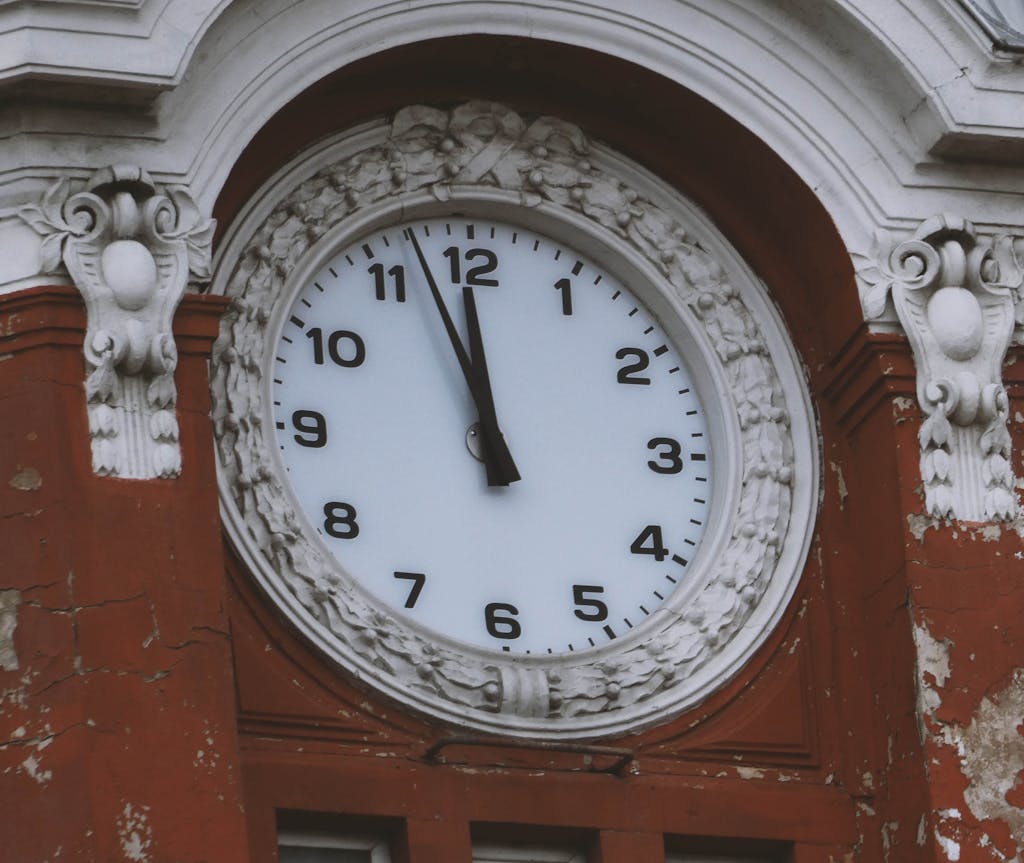
But midnight isn’t the end of the building. It’s the dark hallway between what we were and what we’re going to become. Every reset in history has felt like a termination to the people living through it. And every single time, on the other side, something new was built by the people who carried the seeds through the fire.
The Apostle Paul wrote that now it is high time to wake out of sleep, because the night is far spent and the day is at hand. That’s not a warning to be afraid. It’s a call to be awake. To recognize the moment for what it is. To cast off what no longer works and put on what does.
I’m 77 years old. I’m standing in a crumbling stone house in rural France with dirt under my fingernails and a 9th-century plant list pinned to my kitchen wall. And I have never in my life been less afraid of what’s coming.
Because I’m not watching the waves. I’m reading the tide. And the tide says: the old ways aren’t outdated. They’re just waiting for us to make them new again.
What You Can Do Right Now
You don’t have to move to France. You don’t have to grow 70 medieval plants. But you can start carrying seeds.
Learn to grow something that feeds you. Learn to make something that heals you. Learn the name of a plant your grandmother knew and find out why she knew it. Write something down by hand that you want your grandchildren to read. Build something — anything — that’s meant to outlast you.
Because the gears are turning, and they don’t wait for us to be ready. But the beautiful thing about a reset is that it’s also a beginning. The question isn’t whether midnight is coming. The question is what you’re carrying in your hands when it arrives.
I know what I’m carrying. Seventy plants. A stone house. A faith that has outlasted every empire that ever tried to contain it. And a stubborn conviction that the old ways still have something to teach us, if we’re willing to get our hands dirty and listen.
The clock is striking midnight. But the day is at hand.
God bless.
The video that inspired this reflection is “Midnight Is Here“ from the Black Sheep channel on YouTube. I’d encourage you to watch it in full.
