

Importance of Remembrance: Poppies, Bleuets and Two Minutes of Silence from a French Village
| Why does remembrance matter? Remembrance keeps the cost of our freedom in front of us, so the next generation knows what was paid and by whom. It honors the people who served and the people they left behind, and it gives us a reason to live worthy of them. A people that stops remembering soon stops understanding what it has. |
This morning at eleven o’clock London time, Big Ben struck the hour, a single gun fired from Horse Guards Parade, and Britain went quiet for two minutes. Here in Clugnat it was noon, the hour our church bells ring every day. I have been thinking all week about the importance of remembrance, and about what it means to keep it in a world where monuments are defaced and riots seem to come every other day. What would the men and women who laid down their lives for our freedom think of us now?
November is the month of remembering. All Saints has just filled the French cemeteries with chrysanthemums. On Wednesday, 11 November, France closes its shops for Armistice Day, and every village gathers at its monument aux morts. Americans honor their veterans the same day, and before the month is out we sit down to Thanksgiving, the one feast of this season I keep with my whole heart.
Where the Two-Minute Silence Came From: Importance of Remembrance
The silence began with two men who may never have compared notes. In May 1919 an Australian journalist named Edward George Honey, a veteran living in London, wrote to the Evening News suggesting five minutes of silence on the anniversary of the Armistice.1 The idea went nowhere at first. That autumn Sir Percy Fitzpatrick of South Africa, whose son Nugent had been killed on the Western Front in December 1917, put a similar idea to King George V. Cape Town had kept a daily pause at noon through the last year of the war, and Fitzpatrick had seen what it did for people.2
Five minutes was tried and found too long. Two minutes became the custom, and tradition gives each minute its own work: one for the dead, and one for those who survived and had to go on living. On 7 November 1919 the king asked the whole Empire to stop at the eleventh hour of the eleventh day. Four days later buses pulled up in the middle of the road and men stood with bowed heads on the floor of the Stock Exchange.
I love that second minute. Remembrance belongs to the widow, and to the boy who came home with his lungs ruined by gas, as much as to the names carved in stone.
Why Do We Wear Poppies? A Doctor, a Teacher and a Frenchwoman
The poppy came out of a poem. In May 1915 John McCrae, a Canadian army doctor at Ypres, buried his friend Lieutenant Alexis Helmer. The next day, looking out at the graves where wild poppies were already blooming, he wrote “In Flanders Fields.” Punch printed it that December without his name, and it became the most widely read poem of the war.3
In 1918 an American teacher, Moina Michael, read it and promised to wear a red poppy as a sign of remembrance. Then a Frenchwoman carried the idea around the world. Anna Guérin had widows and orphans in the devastated regions of France make silk poppies to sell for war relief. She took them to the American Legion, then to Canada, and in 1921 to the newly formed British Legion, even offering to fund the first million poppies herself.4 The first British Poppy Day that November raised more than £100,000 for veterans who needed work and homes.
So every November, the lapels of Britain carry an idea a French widow’s work made possible. That still makes me smile.
Why France Wears the Bleuet Instead
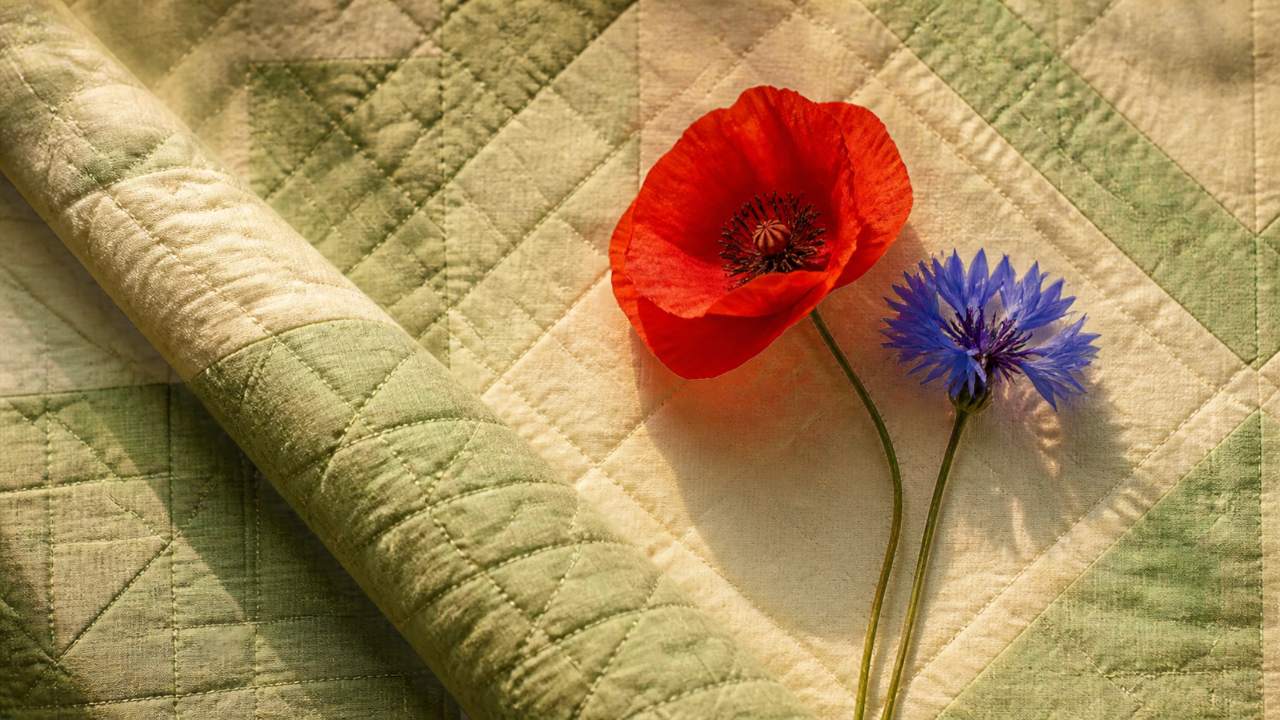
France chose a different flower. The bleuet de France, the blue cornflower, began in 1918 with two nurses at the Institution Nationale des Invalides in Paris, who set wounded soldiers to making cloth cornflowers.5 The cornflower kept blooming in the shell-torn fields just as the poppy did, and its blue matched the horizon-blue uniforms of the young recruits the French called les bleuets. From 11 November 1934 it was sold across France on Armistice Day, and the money still goes to veterans, war widows and victims of war.6 You will see it pinned to coats at our monument on Wednesday.
Remembrance Sunday, Armistice Day and Veterans Day: What’s the Difference?
All three come from the same morning in 1918, when the guns on the Western Front fell silent at eleven o’clock. What each country did with that date afterward is where they part ways.
Britain and the Commonwealth keep the focus on the dead. Armistice Day is always 11 November, and since the Second World War the main national service has been held on Remembrance Sunday, the second Sunday of November, so the country does not have to stop work in the middle of a weekday.
America turned the day toward the living. A Navy veteran from Birmingham, Alabama, named Raymond Weeks began holding an Armistice Day celebration for all veterans after the Second World War, and in 1954 President Eisenhower signed the law that renamed it Veterans Day.7 America’s day for its war dead is Memorial Day, at the end of May.
France keeps 11 November as a public holiday, with ceremonies at the Arc de Triomphe and at the monument aux morts in nearly every commune. The losses behind it are staggering: the Great War cost France close to two million dead and missing, soldiers and civilians together.8
The Cenotaph: An Empty Tomb for the Men Who Never Came Home
Britain’s national memorial is called the Cenotaph, from the Greek for “empty tomb.” Sir Edwin Lutyens first built it in wood and plaster for the Peace Day parade of July 1919. So many mourners left flowers at its foot that it was rebuilt in Portland stone and unveiled on 11 November 1920, the same day the Unknown Warrior was carried past it on his way to burial in Westminster Abbey.9 It carries no names and no religious images. It stands for the hundreds of thousands who were buried where they fell, many of them in French soil.
Lutyens hid a lovely detail in it. The sides are not truly upright. They lean inward so slightly that, if you carried them on upward, they would meet about a thousand feet above the street.
All Saints and the People Who Are on No Monument
France keeps All Saints, la Toussaint, on 1 November, and in the days around it the cemeteries fill with pots of chrysanthemums. That is why no French hostess wants chrysanthemums brought to her dinner table. Whatever you make of the church calendar, I love what the custom says. Everyone has saints in the plain sense of the word: the faithful, ordinary people who taught us, fed us and prayed for us. None of them will ever have their names on a monument, and remembrance belongs to them too.
Remembering at the Table: Why Thanksgiving Is My Feast
I don’t keep Christmas, so for me Thanksgiving is the feast of the season. It is remembrance with a full plate. Moses warned Israel that the danger comes after the meal, when you have eaten and are full, because that is when people forget who gave them the land. Thanksgiving answers that warning. You eat, you are full, and then you say thank you out loud, to God and to the people around the table.
Every family has dishes that carry somebody with them. Mine is skillet cornbread, baked in a preheated cast iron pan, with no sugar in it, ever. When I make it I am not alone in the kitchen. Which dish does that for you? Tell me in the comments.
How to Keep Remembrance at Home
- Keep the two minutes. At 11 a.m. on 11 November, stop wherever you are, at the stove, in the car or at your desk.
- Make a memory quilt. A square from a uniform shirt, a grandfather’s handkerchief, a mother’s apron. I am a seamstress, and I can tell you a quilt keeps a story better than a drawer does.
- Write the names down. Put the names and dates of the veterans in your family in the front of your Bible or a family book, with one line about each.
- Visit your memorial. Read the names aloud. In a French village you will often find the same surnames on the monument as on the letterboxes.
- Cook the old recipe. Make the dish someone in your family made, and tell the children whose it was.
- Wear a poppy or a bleuet, and give to the veterans it supports.
The past isn’t gone. It’s still here, waiting, and it’s never too late to go and find it. That is true of the men on our monument, of the woman who sold the first poppies, and of whoever taught you your favorite recipe. Remembering them costs two minutes and a little attention, and it is a small thing to give for so much.
Frequently Asked Questions
When is Remembrance Sunday 2026?
Sunday 8 November 2026. It is always the second Sunday in November. Armistice Day is 11 November, which falls on a Wednesday this year.
Why is the silence two minutes long?
Five minutes was tried in 1919 and found too long. By tradition, the first minute is for the dead and the second for those who survived and had to carry on.
Why do people wear poppies?
Poppies bloomed on the battlefields of Flanders and inspired John McCrae’s 1915 poem “In Flanders Fields.” An American teacher, Moina Michael, and a Frenchwoman, Anna Guérin, turned the poppy into a symbol that raises money for veterans.
What flower do the French wear for remembrance?
The bleuet de France, the blue cornflower, worn around 11 November and 8 May. It began in 1918 with two nurses at Les Invalides in Paris.
What is the difference between Veterans Day and Remembrance Day?
Both fall on 11 November. Remembrance Day honors those who died. America’s Veterans Day, renamed in 1954, honors everyone who served. Memorial Day in May is America’s day for the war dead.
What does cenotaph mean?
Empty tomb, from the Greek. A cenotaph honors people who are buried somewhere else or were never found.
How can I observe Remembrance Day at home?
Keep the two minutes at 11 a.m., write down the names of your family’s veterans, visit a local memorial, and wear a poppy or a bleuet.

©2026 Carolyn Smith-Kizer
If this work is useful to you, you can buy me a coffee — buymeacoffee.com/cskizer
Notes
1. “Curious Questions: When Did We Start Observing a Silence in Remembrance of the Victims of War?” Country Life, accessed November 8, 2026, https://countrylife.co.uk/?p=188444.
2. “The Traditional ‘Two Minutes Silence in Remembrance’ Was First Observed in Cape Town,” The Heritage Portal, accessed November 8, 2026, https://www.theheritageportal.co.za/article/traditional-two-minutes-silence-remembrance-was-first-observed-cape-town.
3. John McCrae, “In Flanders Fields,” Punch, December 8, 1915.
4. Royal British Legion, “Anna Guérin,” accessed November 8, 2026, https://www.britishlegion.org.uk/stories/anna-guérin.
5. Préfecture de la région Grand Est, “Le Bleuet de France – 8 mai 2021,” accessed November 8, 2026, https://www.prefectures-regions.gouv.fr/grand-est/Actualites/Culture-patrimoine/Le-Bleuet-de-France-8-mai-2021.
6. Préfecture du Val-d’Oise, “Le Bleuet de France,” dossier de presse, November 2014, val-doise.gouv.fr.
7. U.S. National Archives, “The Origins of Veterans Day,” Prologue: Pieces of History (blog), accessed November 8, 2026, https://prologue.blogs.archives.gov/?p=37781.
8. Ministère de l’Éducation nationale, “Journée nationale du 11 novembre,” Éduscol, accessed November 8, 2026, https://eduscol.education.gouv.fr/6420/journee-nationale-du-11-novembre.
9. Imperial War Museums, “What Is the Cenotaph?” accessed November 8, 2026, https://www.iwm.org.uk/history/what-is-the-cenotaph.
