
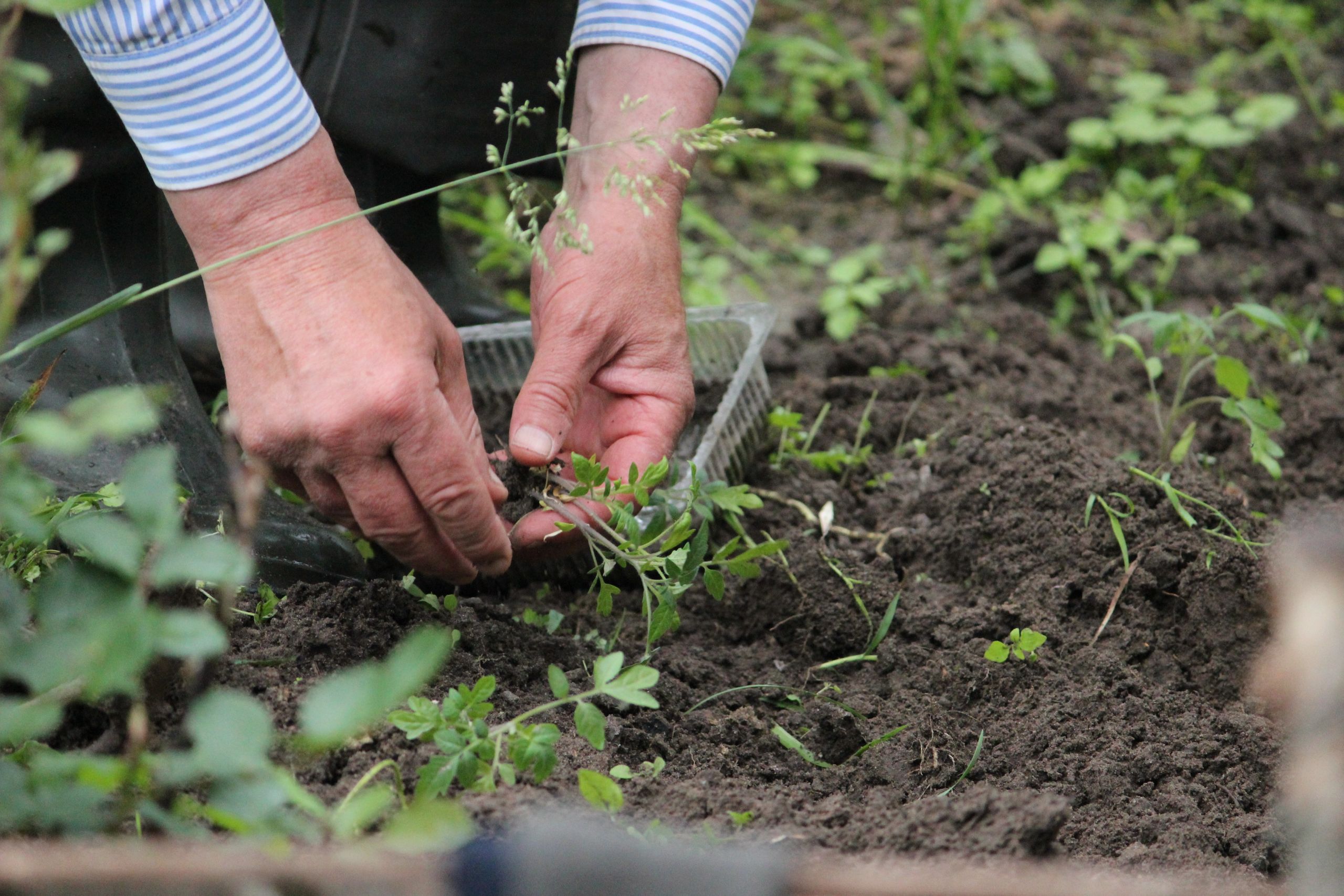

Gardening Health Benefits: Why I Let My Garden Mud My Hands
A herbalist’s case for getting dirty — with the science to back it up.
I live in a 170-year-old stone house in a village in the Creuse. My garden is 632 square metres of beds, paths, and possibility, and on any given morning you will find me in it with bare hands and muddy knees.
This is not a lifestyle affectation. It is, I have come to understand, one of the most important things I do for my health — and for the health of anyone who spends time working soil, wading through puddles, or letting a child make a proper mud pie.
The gardening health benefits I’m describing here aren’t about fitness or fresh air, though those matter too — they go deeper, into the immune system itself.
We Are Made of Dust — and We Need It Back — Gardening Health Benefits
The book of Genesis says that the first human was formed from the dust of the ground. The Hebrew word for that ground is adamah — soil, earth, the living stuff beneath our feet. Whatever you make of the theology, the biology confirms something similar: we evolved in continuous, intimate contact with the microbial world of the earth. Our immune systems were shaped by that contact over hundreds of thousands of years.
And then, in the space of about two generations, we put rubber soles between our feet and the ground, poured concrete over the living soil, moved our children indoors, and called it progress.
Our immune systems noticed.
The Amish and the Hutterites: A Natural Experiment
In 2016, a team of researchers published a striking study in the New England Journal of Medicine comparing two communities — the Amish of Indiana and the Hutterites of South Dakota. These groups share remarkable similarities: large families, traditional diets, raw milk, minimal television, no indoor pets, low obesity rates, high vaccination rates. Genetically, they are nearly identical, both tracing to Central European Protestant communities of the 1700s.
But their asthma rates are not identical at all.
Asthma among Amish children: 5.2%. Among Hutterite children: 21.3%. Allergic sensitization: 7.2% versus 33.3%.
The difference? The Amish practice traditional farming. They live close to their animals, work with horses, and their homes are rich in the kind of microbial dust that comes from living in genuine contact with the land. The Hutterites farm industrially, at a remove from the biological world of their fields.
When researchers measured endotoxin levels — the bacterial signatures in household dust — Amish homes had levels 6.8 times higher than Hutterite homes. And when they took that Amish dust and gave it to mice prone to allergic asthma, the mice were protected. Hutterite dust provided no such protection.
The protection required something called innate immune signalling — the ancient, rapid-response layer of the immune system that reads the microbial environment and calibrates the body’s responses accordingly. When that signalling pathway was disabled in the mice, the protection vanished.
In other words: the microbial richness of the Amish environment was actively training the immune system not to overreact. The Hutterite children’s immune systems, deprived of that calibration, were firing at shadows.
The Earthing Question
There is a separate but complementary line of research suggesting that direct physical contact with the earth — bare feet on soil, grass, or stone — may have measurable effects on inflammation and the autonomic nervous system.
The proposal, sometimes called ‘earthing’ or ‘grounding,’ is that the earth carries a mild negative electrical charge, and that chronic disconnection from it — through rubber-soled shoes, synthetic flooring, elevated living — may contribute to chronic low-grade inflammation. The free electrons available through direct skin contact with the earth are proposed to act as antioxidants, quenching the free radicals that drive inflammatory processes.
The research here is preliminary and should be held lightly. But it points in the same direction as the immunological work: the human body evolved expecting certain inputs from the physical earth, and our modern built environment has systematically removed them.
What the Forest Kindergartens Know
The Scandinavian tradition of friluftsliv — free air life — and the forest kindergarten movement emerging from Denmark and Germany in the 1950s have long understood something that neuroscience is now catching up with: unstructured time outdoors, including the freedom to get genuinely dirty, builds not just immune resilience but neurological resilience.
Children who spend time in unstructured outdoor environments show better stress regulation, stronger executive function, and higher levels of intrinsic curiosity. The child who is allowed to follow a worm down into the soil, to jump into the puddle and feel what mud does between the fingers, is practising self-directed inquiry — the foundation of a learning life.
We were not designed for carpet and climate control. We were designed for the changing textures of the physical world.
Practical Earthing: Ten Ways to Get Back to the Ground
You do not need a garden, or a farm, or even a village. You need intention, and a willingness to be a little less tidy.
- Garden with bare hands whenever the weather allows. Even ten minutes of contact with living soil counts.
- Walk barefoot on grass, earth, or stone. Not pavement — find a park, a garden, a riverbank.
- Let children make mud pies. Resist the urge to intervene with wipes.
- Grow something in a pot of real soil on a balcony or windowsill, and handle that soil regularly.
- Visit a farmers’ market and handle unwashed vegetables — the kind that still have the earth on them.
- If you have access to animals, spend time with them. The microbial world they carry is part of the calibration.
- Sit on the ground outside rather than on a chair or blanket when the ground is dry.
- In winter, handle root vegetables fresh from the ground — parsnips, celeriac, Jerusalem artichokes.
- Grow herbs in containers you can put your hands into: sage, thyme, rosemary all do well in pots.
- When it rains, go outside anyway. Petrichor — the smell of rain on dry earth — is caused by geosmin, a compound produced by soil bacteria. You are literally inhaling the microbial world.
We are, as the oldest story tells us, creatures of the ground. The science is catching up with what the body has always known: that the earth is not just our home but our calibrator, our teacher, our medicine.
Get your hands in it.

©2026 Carolyn Smith-Kizer, Clugnat, Creuse
Find more at The Little Old Lady on YouTube

Paypal: paypal.me/thelittleoldlday10

Scientific reference:
Stein MM et al. Innate Immunity and Asthma Risk in Amish and Hutterite Farm Children. New England Journal of Medicine. 2016;375(5):411–421. doi:10.1056/NEJMoa1508749.
